Why Your Grill Will Never Be the Same After You Try Japanese Charcoal
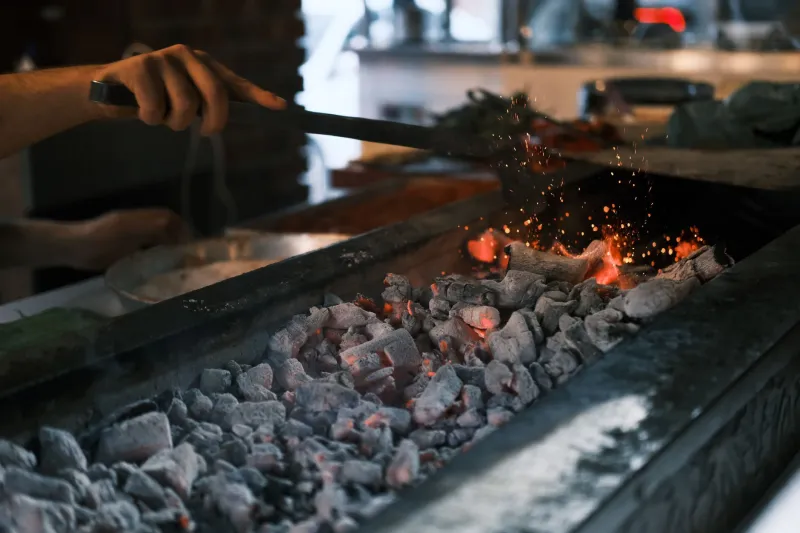
Let's be honest — most of us have never thought too hard about the charcoal sitting in our grills. You grab a bag at the hardware store, maybe squirt on some lighter fluid, and call it a day. But here at Fuji Grill USA, we believe the fuel you choose is just as important as the cut of meat or the marinade you spent two hours perfecting. And when it comes to fuel, Japanese charcoal isn't just different — it's in a different category entirely.
So what's actually going on inside that bag of binchotan? And why are serious grill enthusiasts across the country making the switch? Let's dig in.
The Ancient Art of Charcoal Making in Japan
Japan has been obsessing over charcoal quality for well over a thousand years. The most prized variety, binchotan (also called white charcoal or 備長炭), traces its origins to the Edo period, when a charcoal maker named Bichuya Chozaemon in the Kishu region of present-day Wakayama Prefecture developed a unique high-temperature firing process. The result was a charcoal so dense, so pure, and so long-burning that it became the gold standard for Japanese cooking — and it's still produced using largely the same method today.
Traditional binchotan is made from ubame oak (Quercus phillyraeoides), fired in clay kilns at temperatures exceeding 2,000°F. The wood is then rapidly cooled with a mixture of ash, sand, and earth — a process that gives the charcoal its distinctive pale, almost metallic appearance. That dramatic quenching is what creates binchotan's uniquely hard, glass-like structure and its remarkably low moisture content.
Compare that to how most American briquettes are made: compressed sawdust, coal dust, and binding agents like cornstarch or sodium nitrate, formed into uniform pillow shapes and designed more for consistency and convenience than for cooking performance. There's nothing wrong with that for a casual cookout, but it's a fundamentally different product with fundamentally different results.
The Heat Science That Changes Everything
Here's where things get genuinely interesting from a cooking standpoint.
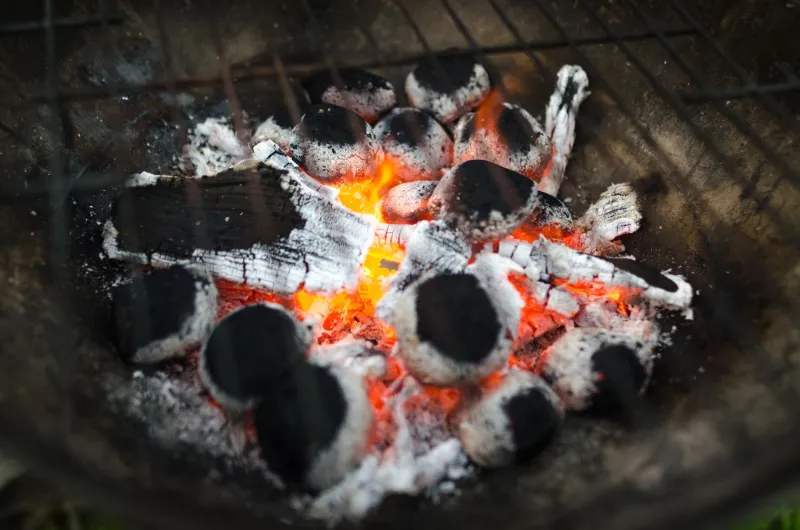
Binchotan burns at a steady, radiant heat typically between 1,300°F and 1,500°F at the surface, with almost no flame. That's a key distinction. Standard briquettes produce open flames and fluctuating temperatures, which means you're constantly managing flare-ups and uneven cooking zones. Binchotan, by contrast, behaves more like a powerful infrared heating element — consistent, controllable, and deeply penetrating.
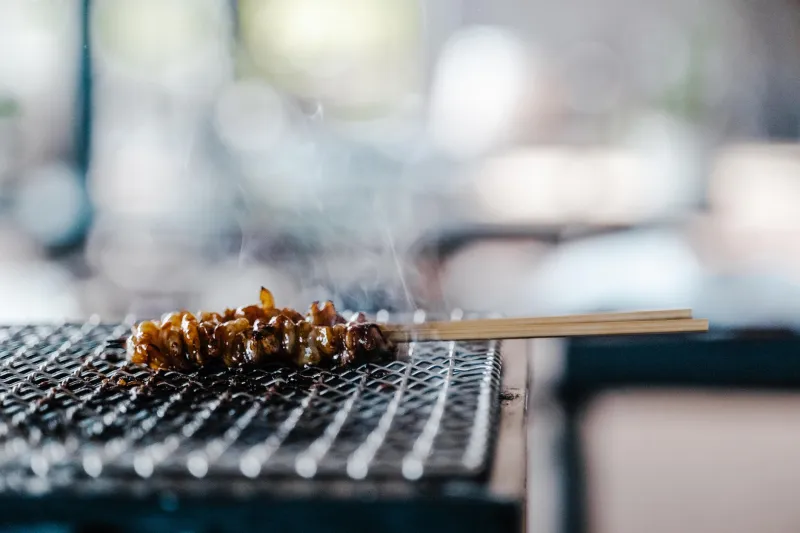
This radiant heat does something remarkable to proteins. Rather than cooking food from the outside in (which can leave the exterior overdone before the center catches up), the even infrared energy from binchotan penetrates more uniformly. Yakitori chefs in Japan have relied on this principle for generations to achieve that perfect char on the outside while keeping chicken thigh skewers juicy and tender through the middle.
Burn time is another area where binchotan leaves American briquettes in the dust. A standard bag of briquettes might give you 45 minutes to an hour of reliable cooking heat. Quality binchotan? Easily three to five hours of sustained, steady temperature — and experienced grill cooks can even extinguish it, store it, and relight it for the next session. That reusability alone makes the higher upfront cost much easier to justify.
What About Flavor? Does the Charcoal Actually Matter?
This is the question we get most often, and the answer is a clear yes — but maybe not for the reasons you'd expect.
Standard briquettes, especially cheaper varieties, can contain additives and binders that produce off-flavors, particularly during the early stages of burning. That's part of why most grilling guides tell you to wait until the briquettes are fully ashed over before cooking. Binchotan, because it's essentially pure carbonized wood with almost no additives, produces very little smoke and virtually no unpleasant chemical odor. What you taste on your food is clean, pure, wood-kissed flavor — nothing more, nothing less.
Several grill masters we've spoken with describe the difference as similar to cooking in a high-end restaurant versus a fast-casual chain. The ingredients are cleaner, the process is more refined, and the result speaks for itself.
Japanese oak charcoal (nara sumi), a slightly more affordable cousin to binchotan made from sawtooth oak, offers a similar clean burn with a touch more smoke character — making it a popular choice for American grillers who want some of that familiar smoky BBQ quality alongside the precision of Japanese-style heat.
Other Japanese Charcoal Varieties Worth Knowing
Binchotan gets most of the attention, but it's not the only game in town:
- Ogatan – A compressed charcoal made from sawdust, shaped into hexagonal or square logs. Burns evenly and is more affordable than binchotan, making it a solid entry point for newcomers.
- Nara Sumi (Oak Charcoal) – More aromatic than binchotan, produces a gentle smoke that complements beef and pork beautifully. Great for American-style cuts.
- Coconut Shell Charcoal – Not traditionally Japanese, but widely used in Asian grilling contexts. Burns clean and hot, and is an eco-friendly option gaining traction in the US market.
Practical Buying Guide for US Consumers
Ready to make the switch? Here's what you need to know before you shop.
Where to buy: Authentic binchotan is available through several online retailers including Korin, Japan Centre USA, and a growing number of specialty BBQ stores. Some Asian grocery chains in major cities like Los Angeles, New York, San Francisco, and Chicago carry it as well. Always check the origin — genuine Kishu binchotan from Wakayama Prefecture commands a premium for good reason, while cheaper imitations from other countries may not offer the same performance.
What to expect to pay: Authentic binchotan runs anywhere from $25 to $60 for a 2-3 lb package. That sounds steep compared to a $12 bag of briquettes, but remember the reusability factor. Many grillers find that a single session's worth of binchotan can be used two or three times over.
Lighting tips: This is where many beginners get frustrated. Binchotan does NOT light easily with a standard chimney starter or lighter fluid. You need a dedicated charcoal chimney placed directly over a gas burner, or a specialized electric charcoal lighter. Give it 20-25 minutes before transferring to your grill. The patience is absolutely worth it.
Grill compatibility: Binchotan works best in a konro grill (a narrow, rectangular Japanese clay or diatomaceous earth grill designed specifically for this type of charcoal), but it performs well in any charcoal grill with good airflow control. At Fuji Grill USA, our grill setups are engineered to maximize the performance of Japanese charcoal in an American backyard context.
Making the Switch
Switching to Japanese charcoal isn't just about being a food snob — though we won't judge you if that's part of the appeal. It's about understanding that every variable in the grilling process contributes to the final result, and that the fuel is one of the most underrated variables of all.
Once you've tasted chicken skewers or a ribeye cooked over binchotan's clean, radiant heat, the difference is hard to ignore. The flavors are cleaner, the texture is more consistent, and the whole experience feels more intentional — more connected to a tradition of craft that stretches back centuries in Japan.
That's the spirit behind everything we do at Fuji Grill USA. We're not trying to replace American BBQ culture. We're here to add a layer of depth, precision, and history to it. And it starts with what's burning beneath your grates.