Hot, Hotter, Barely There: How Japanese Heat Zoning Is Changing the Way Americans Grill
Ask a seasoned pitmaster about temperature control and they'll talk about the low-and-slow gospel — 225°F for hours, smoke rings, bark development, collagen breakdown. Ask a Japanese robata or yakitori chef the same question and you'll get a completely different answer, one that sounds almost contradictory: they'll tell you they cook at extremely high heat and extremely low heat, sometimes within seconds of each other, and that the precise movement between those zones is what separates good grilled food from exceptional grilled food.
This isn't a philosophical debate about BBQ styles. It's a functional difference in technique that produces measurably different results in texture, moisture retention, and flavor development. And increasingly, American home cooks and professional chefs are paying close attention.
The Western Default: Why Two Zones Isn't Enough
The standard American grilling setup — whether gas or charcoal — tends to operate on a binary logic. You've got your hot side for searing and your cooler side for indirect cooking. That two-zone method is genuinely useful and produces great results for a lot of proteins, particularly larger cuts that benefit from the reverse-sear approach.
But it leaves a lot on the table. The gap between "searing hot" and "indirect medium" is enormous, and most of the interesting cooking actually happens in the middle ranges and at the extremes — ranges that Western grilling rarely maps with precision.
Japanese grilling tradition, particularly in izakaya and robata contexts, treats heat as a continuous spectrum with multiple distinct zones, each serving a specific purpose. Understanding what those zones are and why they work the way they do is the foundation of better grilling, full stop.
Zone One: The Sear Zone (900°F and Above)
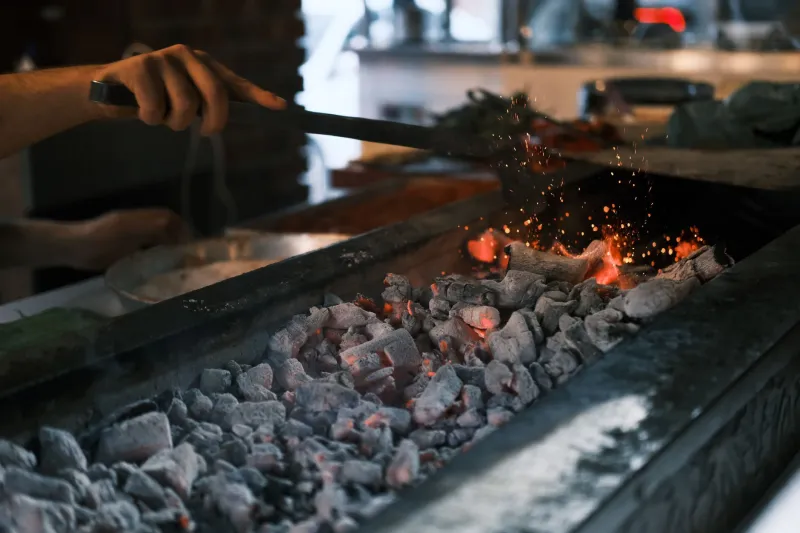
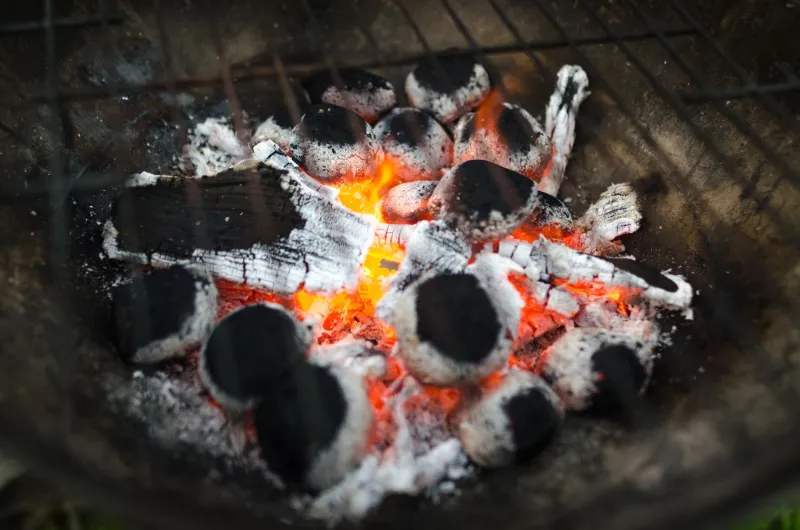
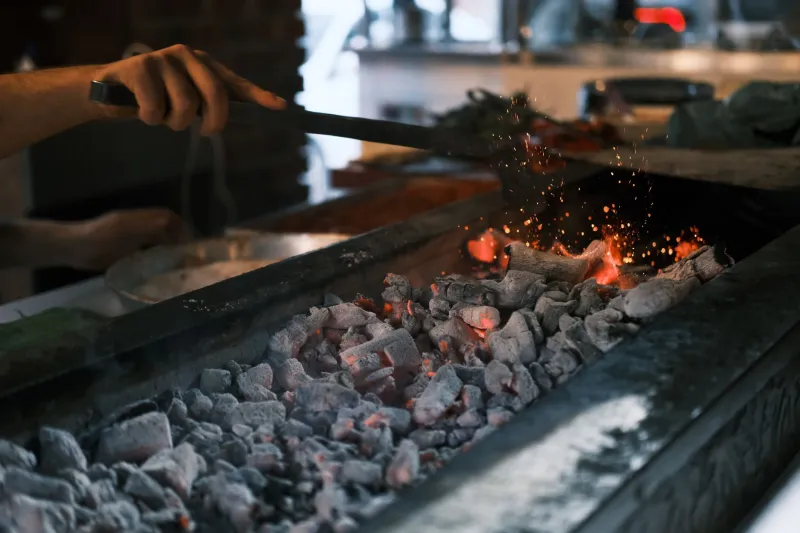
Binchotan charcoal — the dense, ultra-refined white charcoal used in traditional Japanese grilling — burns at surface temperatures that can exceed 1,400°F under optimal airflow conditions. That's significantly hotter than what standard briquettes achieve, and the heat is radiant rather than convective, meaning it transfers directly to the food's surface without the surrounding air temperature playing a major role.
The practical effect? You get a Maillard reaction — the browning and crust development that creates flavor — happening almost instantaneously. A chicken thigh over binchotan at peak heat develops a caramelized exterior in seconds, not minutes. That speed matters because it limits moisture loss. The faster you can develop a crust, the less time the interior has to start losing its juices to evaporation.
For American proteins, this principle translates directly. A ribeye steak seared over binchotan at peak heat for 60 to 90 seconds per side develops a crust with a depth of flavor that a gas grill at 600°F simply cannot match in the same timeframe. The physics are different.
Zone Two: The Development Zone (400–600°F)
This is where Japanese technique gets subtle and where most Western grilling approaches lose the thread. After the initial sear, skilled Japanese grillers move food to a mid-range heat zone — not to "finish" the cook in a generic sense, but to manage the internal temperature rise with precision.
At 400 to 600°F over well-managed binchotan, proteins continue cooking without the surface temperature escalating further. The crust that formed in Zone One stabilizes. Fat renders slowly and evenly. Collagen in fattier cuts begins to soften without the exterior burning.
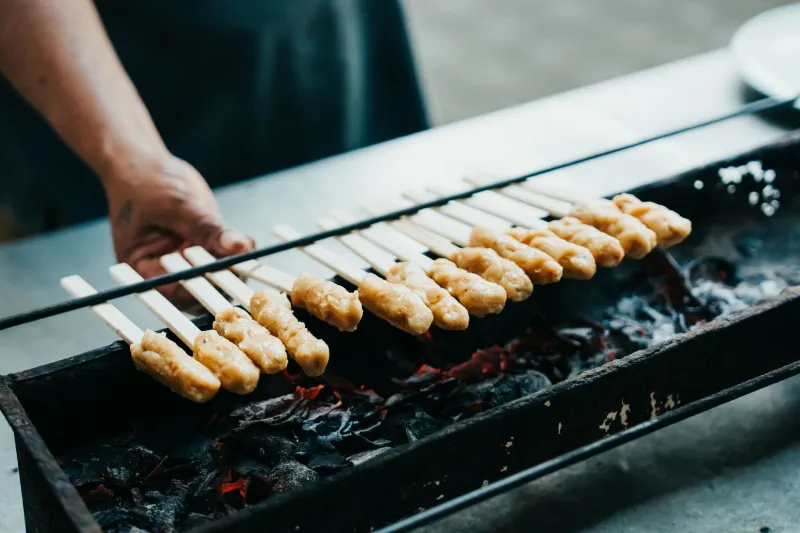
In izakaya kitchens, chefs are constantly moving skewers between these zones, rotating them not just to prevent burning but to actively manage which part of the protein is receiving which level of heat at any given moment. It's a dynamic process, not a static one. The grill isn't set and forgotten — it's played like an instrument.
Zone Three: The Rest Zone (Under 250°F)
Every serious yakitori or robata cook maintains what amounts to a warming lane at the edge of the grill — an area where coals are thin or absent, producing ambient heat rather than direct radiant heat. This is where skewers go to rest between sauce applications, where finished pieces hold while you complete the rest of the order, and where delicate items like tofu or certain fish can cook through gently without ever touching intense heat.
In Western grilling terms, this is roughly analogous to the indirect zone, but the key difference is intentionality. Japanese grillers use this zone actively, moving food in and out of it as part of the cooking process rather than just parking things there to avoid burning them.
For home cooks, creating this zone on a standard charcoal setup is straightforward: bank your coals to one side and leave one-third of the grate completely clear. On a dedicated konro grill, you can achieve it by controlling the air intake vents to reduce oxygen flow on one end of the firebox.
Applying This to American Proteins
Here's where the rubber meets the road. You don't have to be cooking chicken skewers to benefit from Japanese heat zoning principles. They apply directly to the proteins Americans already love.
Burgers: Sear over maximum heat for 45 seconds per side to develop crust, then move to the development zone to bring the interior to temperature. The result is a burger with more surface flavor and a juicier interior than the standard "press it down and flip once" approach.
Pork chops: These are notorious for drying out on American grills because people cook them entirely over medium-high heat. A quick blast in Zone One followed by slow development in Zone Two produces a chop that's caramelized outside and still has moisture in the center.
Salmon: Delicate fish benefits enormously from starting in Zone Three (gentle heat) to warm through, then getting a brief finish in Zone One for skin crispness. Reverse the typical order and you'll stop overcooking fish.
Chicken thighs: Bone-in thighs are already forgiving, but Japanese-style heat management takes them to another level. High-heat searing renders the skin to a lacquered crispness that low-and-slow cooking never achieves.
The Mindset Shift
The deeper lesson from Japanese heat management isn't really about specific temperatures or zone configurations — those are just tools. The underlying principle is that the cook's job is to actively manage the relationship between fire and food throughout the entire cook, not just at the beginning and end.
American grilling culture has long celebrated the "set it and forget it" approach, particularly in the low-and-slow BBQ tradition. That approach produces genuinely great food. But Japanese technique suggests there's an entire dimension of grilling that opens up when you stay engaged with the fire, when you treat heat as something to be navigated rather than simply applied.
At Fuji Grill USA, that philosophy is baked into everything we talk about. The fire isn't just a heat source. It's the most important ingredient on the grill — and learning to work with it the way Japanese masters do will change what comes off your grates, one zone at a time.