Your Kitchen, Your Izakaya: A No-Nonsense Guide to Setting Up Japanese Grilling at Home
Let's be honest about something: most American kitchens were not designed with robata-style cooking in mind. Our homes are built around six-burner gas ranges, wide refrigerators, and the assumption that if something smokes, something has gone wrong. Japanese grilling flips that assumption on its head — smoke is a feature, not a bug — and that creates some real logistical questions for anyone trying to make the transition.
But here's the good news: you don't need to gut your kitchen, buy a plane ticket to Tokyo, or spend thousands of dollars to cook authentic Japanese-style grilled food at home. You need a plan. This is that plan.
First, Honest Talk About Ventilation
Indoor Japanese grilling — particularly robata or konro-style cooking over binchotan charcoal — produces smoke. Not alarming amounts, but enough that your smoke detector will have opinions about it if you're not prepared.
Before you fire up anything indoors, assess your kitchen's ventilation situation:
Range hood CFM matters. CFM stands for cubic feet per minute — it's the measure of how much air your hood can move. For serious indoor grilling, you want at least 400 CFM. Most standard American range hoods top out around 200–300 CFM, which is fine for stovetop cooking but undersized for charcoal smoke. If your hood is underpowered, consider a window fan positioned to exhaust air outward, or simply move your setup to a covered patio.
Open windows strategically. Cross-ventilation — one window open on each side of the cooking area — moves air through rather than just circulating smoke around the room. This makes a surprisingly large difference.
Carbon monoxide is the real concern. Binchotan charcoal burns cleaner than standard charcoal, but it still produces CO. Never use charcoal in an enclosed space without serious airflow. A CO detector near your cooking area isn't optional — it's non-negotiable. Most hardware stores carry them for under $30.
For most American home cooks, the safest and most practical solution is a covered outdoor setup: a small patio, a balcony with clearance from walls, or even a garage with the door open and a fan running.
Small Space? No Problem.
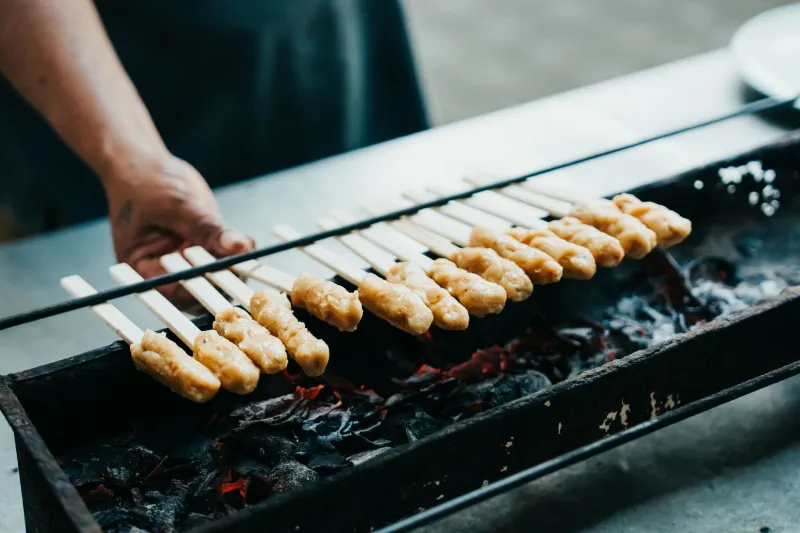
Yakitori setups are among the most space-efficient grilling configurations in the world. A traditional konro grill — the rectangular ceramic tabletop unit used in izakayas across Japan — is typically 6 to 12 inches wide and 12 to 24 inches long. That's smaller than most Americans' cutting boards.
For apartment dwellers or anyone with a compact patio:
- A tabletop konro grill is your best friend. Brands like Yakiniku and various Japanese import options available through specialty retailers fit on a folding table or outdoor cart with room to spare. Fuji Grill USA carries several configurations suited to small-space cooking.
- A compact hibachi setup works as an entry point if you're not ready to commit to a dedicated yakitori grill. Cast iron hibachis are widely available and handle skewers well when loaded with real hardwood charcoal.
- Vertical skewer racks let you cook more skewers simultaneously without expanding your grill's footprint. They're inexpensive and make a real difference when you're feeding more than two people.
For those with slightly more outdoor real estate, a dedicated yakitori station — a longer konro grill paired with a prep table and a simple hook rail for tools — transforms even a modest deck into something that feels genuinely intentional.
Retrofitting What You Already Have
Not everyone is ready to buy new equipment, and that's completely fine. Your existing grill can do a lot more Japanese-style cooking than you might think, with a few smart modifications.
Kettle grill owners: You're in great shape. A standard Weber kettle accommodates Japanese-style indirect heat setups easily. Use a charcoal basket to concentrate your coals on one side, and place a small metal loaf pan filled with water on the other side for moisture regulation. Skewers rest directly on the grates.
Gas grill owners: Here's where it gets creative. You can approximate binchotan-style cooking by placing a cast iron skillet or griddle over your burners and filling it with real hardwood charcoal (not briquettes). Light the charcoal separately, transfer it to the skillet, and grill over that rather than the gas flame. It's not identical to a konro setup, but it gets you meaningfully closer.
Existing charcoal grill owners: The main upgrade worth making is switching your fuel. Ditch the lighter fluid and the standard briquettes. Switch to real lump charcoal as a baseline, or invest in binchotan if you want to experience the difference firsthand. The grill doesn't change — the fire does.
Regional Considerations Across the US
Where you live affects how you grill, and Japanese-style cooking is no exception.
Southeast and Gulf Coast: High humidity can make charcoal harder to light and keep lit. Store your charcoal in an airtight container and consider a charcoal chimney starter rather than relying on natural draft lighting. Binchotan in particular benefits from a dedicated charcoal starter in humid conditions.
Pacific Northwest: Rain is the obvious challenge. A covered patio or a simple canopy setup keeps your grill functional year-round. The mild temperatures are actually ideal for long, slow yakitori sessions.
Southwest and Mountain West: Dry air and high altitude affect burn rates — charcoal burns hotter and faster at elevation. Reduce your charcoal load slightly and monitor heat more carefully than you would at sea level.
Midwest and Northeast: Winter grilling is absolutely doable with Japanese setups, and frankly, a konro grill on a cold evening with a few skewers and a glass of sake is one of life's underrated pleasures. Preheat your grill longer in cold weather and expect slightly longer cook times.
Sourcing Ingredients Without a Japanese Grocery Nearby
One of the most common questions we hear at Fuji Grill USA: Where do I find the right ingredients?
The answer is more accessible than most people expect.
Chicken thighs — the backbone of yakitori — are at every grocery store in America. Buy bone-in and break them down yourself for better flavor, or pick up boneless thighs for convenience.
Tare sauce can be made from soy sauce, mirin, sake, and sugar — all available at mainstream grocery chains like Whole Foods, Kroger, or even Walmart in most regions. If you want the real deal, look for hon-mirin (real mirin, not corn syrup-based substitutes) at Asian grocery stores or online.
Scallions, shishito peppers, and shiitake mushrooms are widely available at farmers markets and standard grocery stores across the country. These are your yakitori vegetable workhorses.
Binchotan charcoal is available through specialty retailers online, including our own store at fujigrill2us.com, and ships nationwide.
The Bottom Line
Switching to Japanese grilling doesn't require a lifestyle overhaul. It requires curiosity, a few smart adjustments, and a willingness to treat your grill as something worth paying attention to. Start with what you have. Upgrade intentionally. And don't let the perfect setup be the enemy of a really good skewer tonight.